infotrue by RL
ABOUT INFOTRUE ................................................................................................................................................................ CONTACT
COMING LATER IN 2010---
YOU WILL BE ABLE TO PURCHASE YOUR E-BOOK FROM THIS SITE!
Click below to be notified by email when the book will be available...

flags

book cover


BE THE FIRST ON YOUR BLOCK TO READ THIS BOOK.

BY CLICKING HERE YOU CAN LEAVE YOUR NAME AND EMAIL ADDRESS AND YOU WILL BE CONTACTED WHEN THE E-BOOK IS AVAILABLE.

PLEASE WRITE "BOOK" IN THE SUBJECT FIELD. YOU CAN ALSO USE THIS LINK TO CONTACT THE AUTHOR WITH ANY QUESTIONS.


In the meantime, you can scroll down and read some excerpts.


THE GERMAN WITHIN THE JEW:

Reconciling the life of a Gay German Jew


This is not just another Holocaust memoir or Gay Coming Out story, but an insightful, humorous look from a person with a pre-war German Jewish culture. There may not be many pre-war Jews living in Germany today, but their culture was transplanted to America.


The book relates the life of a first generation American baby boomer with a questionably extinct culture. The Reader learns about his family's German history in drips and drabs just as the author discovered these details throughout his life.


The book also indirectly explores the Emancipation of Jews and Gays in Europe and America. It ends with how all of these factors influenced the author's views on Sex, Religion and Politics.


This webpage contains two chapters from the copyrighted manuscript. The title is still a working title.


"BOOK" SIGNING SESSION AT THE UNIVERSITY OF MINNESOTA AT DULUTH
angie book signing
Photos taken while selling my manuscript at the "Book" Signing Ceremony.
The people in the photo were those who invited me to the University in October 2009.


ABOUT
THE AUTHOR

me
Rick Landman is a gay Jewish son of two German Holocaust Survivors, who is now a dual American and German citizen. He is a practicing attorney (with 3 Masters Degrees) and was an adjunct Professor of Planning at NYU. Earlier in his career he was the Executive Director of Real Estate Development for the City of New York.

Having started the Gay Liberation Front at S.U.N.Y. at Buffalo in 1970, he has been active the civil rights movement ever since. He is also a long term member of Congregation Beth Simchat Torah in New York City, as well as a life-time member of Congregation Beth Shalom in Munich, Germany for giving them a pre-Hitler era German Torah scroll. He grew up in New York City as a baby booming, second generation child of two German Jewish refugees. His father was born in Augsburg Germany and was arrested on Kristallnacht and interned in Dachau. He was released and eventually found his way to America and joined the U.S. Army's Third Infantry which liberated Dachau. He was then with the first Americans to enter Munich and Augsburg. The influences of his family history is the starting point of his exploration into reconciliation.
. . . . .
OTHER
RELATED WEBPAGES
Landman Family Stories
Kristallnacht
Torah Returns to Munich
Oettinger Family
. . . . .
German Tour
#1 Nice Jewish Boy turns German #2 Gay and Proud #3 Lesson of the Holocaust #4 Flower Power
. . . . .


flags


PREFACE
As an American, Jewish, gay, German, son of two Holocaust Survivors, I needed some time to reflect on how all of these parts of myself made me who I am. So I took an early retirement to spend more time with my parents, and explore these contradictory parts of me. Even though I had eleven years of college studies with 5 degrees, I never really learned much about the emancipation or treatment of the Jewish or Gay (LGBTQ) Communities in Europe and America. So this is where my new studies began.

The deeper I delved into this topic; patterns of freedom began to appear. Similarities of discrimination and segregation, and the back and forth advancement of one's civil rights, became clear to me. The more I learned about my history, the more I also saw similarities to other minority groups who also were persecuted throughout the centuries.

Although one should not blame the children for the sins of their parents; the traumas of the parents do find their way down through the generations. Every year at Passover, Jews teach their children about what it felt personally like to be slaves in Egypt during Biblical times. So why is it difficult to understand when today's generation of other minorities also feel the pains of past wrongs? It doesn't matter if you are Armenian, or African American, or Native American, or a member of the lesbian-gay-bisexual-transgender community; pain and fear of discrimination also filters down through the generations.

Another pattern of history that I saw was the similarity of who is always fighting against modernity or the enlightenment or the expansion of civil rights or sexual freedoms throughout the past millennium. It wasn't just during the Holocaust that people were persecuted and murdered, but the Nazi era does offer the easiest lesson to learn from since the atrocities were so clear. So by looking at my past experiences and combining what I learned from my exploration, I hope that the Reader will see why I am worried and will question those forces of hate; even if the prejudice has a long tradition.

By reading this book, the Reader will learn about my parents' experience during the Nazi era just as I did; namely, in drips and drabs. Growing up I never knew the full story of how my father was arrested on Kristallnacht and sent to Dachau and was released and went to London then New York to become an American soldier only to return to North Africa and Europe to liberate Dachau and become one of the first Americans to enter his hometown of Augsburg and his grandparent's hometown of Munich.

It was a unique experience growing up gay and Jewish with German culture, in a predominately Christian country that hated Germans as well as homosexuals. Growing up I never knew that German history also included the birthplace of America's modern Reform Jewish Movement and Modern Orthodox Movement as well as the modern Gay Rights Movement. The only period discussed was the 12 years of the Nazi era, and I never learned about the history of lives of the Jews who lived in Germany for the past 400 years.


Henry in Dachau Henry in uniform
The passport picture of my father shortly after being released from Dachau in 1939, and a photo of my father in his army uniform in 1942.


INTRODUCTION
I was a typical American baby boomer. I was born in the early 1950s, into an Ozzie and Harriet suburban family, with a stay-at-home mom who looked like a Jewish Natalie Wood, a quiet, blue-eyed humorous father who fought in World War II, and a super jock older brother. I guess that made me the "Beaver" character in our own Leave it to Beaver show.

Both of my parents were born and raised in Germany. Opa, my mother's father served in the Kaiser's army during World War I and brought his entire family to America just before World War II started. My father was sent to Dachau concentration camp on the day after Kristallnacht and after his release he fled Germany to London and then took refuge in Washington Heights, Manhattan in late 1939. When America joined the war, my father went back to Europe with the Third Army Infantry as an American soldier. His battalion liberated Dachau and he was the first American to enter his hometown of Augsburg. But his side of the family wasn't as fortunate as my mother's; almost everyone else perished in the Nazi death camps.

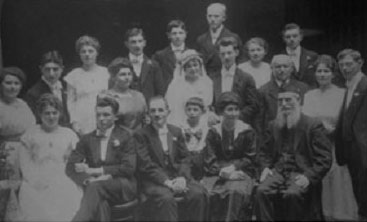
But I didn't know most of this while growing up. Sitting down with my parents planning my Bar Mitzvah, I noticed that the only family members on the invitation list were my three grandparents, my father's siblings, and a two cousins. When I asked why more relatives weren't invited, my mother stared at me blankly while my father quietly got up from the living room sofa and went down to the basement. A few minutes later he came back carrying a small beige cardboard suitcase with a brown and tan stripe down the center. After clicking the brass locks, he opened the lid and removed a large black and white photograph in a hand-made wooden frame. It showed a group of about twenty well-dressed, smiling people. The men wore suits with bow ties and were hatless and clean shaven, except for one elderly man in the front row in a black hat and long white beard. The women wore elegant long dresses with high collars and jeweled pendants around their necks.

portrait
These two are my parents at their wedding,my father said proudly, pointing to a handsome couple in the middle of the picture. The man with the beard is my Grandpa Gerson; next to him is Grandma Sofie. Behind them is Grandpa Moses. My father looked up at me like he was studying my face. These other people are all their sisters, brothers, and in-laws. They would have loved to come to your Bar Mitzvah, but they couldn't get out. Couldn't get out. I'd heard that expression before and knew it referred to family members who were not able to come to America, but I had no understanding of the horrific reality behind that euphemism. My father didn't offer any further details and I didn't ask for them. So I didn't learn that day that most of the people in that photo had been subsequently executed by the Nazis. But a crack had been formed in the foundation of the Cleaver house. As I grew older, the rest of the facts fell into place, culminating in 2005 when I traveled to 20 Ickstattstrasse in Munich saying Kaddish in front of my great-grandparents Gerson and Sophie's apartment house.

My Bar Mitzvah fell on Saturday, June 26, 1965. As fate would have it, I shared that weekend with two other memorable events, one past and one future. Thirty one years earlier, Hitler took the final step in his bloody grab for power by launching the Night of the Long Knives, the first mass execution of Hitler's opponents including Ernst Roehm and his SA thugs. One of the public excuses for their killings was homosexuality. On that same weekend four years later, in 1969, the Stonewall Riots broke out, the violent clash between gays and police that escalated the American Gay Rights Movement.

You now have a glimpse of what it is like being the son of two Holocaust Survivors. For flavor add that since early childhood I knew that I was gay; in 1970 I started the Gay Liberation Front at my college; then add in that as an adult I reinstated my right to German citizenship. Is it any wonder that my life reads like a movie written by Anne Frank, starring Barbra Streisand, directed by Woody Allen and produced by Mel Brooks?

I am reaching out to the right wing and religious fanatics in this world to ask them for a dialogue instead of more violence and terrorism. There must be a way to look globally at our world and find a way to live in peace. Right now I am quite worried about what Muslim, Christian and Jewish fanatics will do in the name of their God, and hope that they remember a time when God was associated with love, tolerance and peace. Maybe we can learn something from turning the other cheek rather than always escalating the sufferings?

During my lifetime, America has moved the arc of history closer to the founder's actual goal of having equality for all. Even George Washington had to face pressures from the anti-civil rights delegates and keep slavery and discrimination alive during his lifetime. But in his Last Will and Testament he freed his slaves. I think this was the beginning of the fight between those who see that America is a shining light of democracy for all. But we are still reacting to the counter-civil rights groups that for millennia have been trying to prevent this from happening. George Washington not only gave America a termed elected president (unlike the Kings of Parliamentary Europe), but he and other founders gave us clues that we should continue to expand all men are created equal, to include African Americans, women, and yes, people of the lesbian, gay, bisexual and transgender community. We are all created in God's image. This is just one reason why I am so proud to be an American.

flags


EXCERPTS

Chapter One:
Ozzie and Harriet with a German accent

Bobby


Picture this: Father's Day, seven years after the end of World War II, and my mother gave my father such a gift that he couldn't return. That was the day I was born and she wouldn't even consider putting me back. I was born precisely on my due-date, thus starting off life with true German punctuality. My mother was the last one to enter the maternity ward that night and was the first woman to give birth. Ivy, a wise friend, quips that when the doctor told my mother to push I assumed he was speaking to me, and I haven't stopped pushing since.

With a Continental flair and an eye on frugality, my parents named me Richard so I could wear the monogrammed hand-me-down clothes from my older brother Robert. They departed from the Jewish tradition of having our first names reflect any of our descendants in favor of choosing safe American names. No one could tell if we were Jewish or German from our given names.

However, the first letter of our middle names and our Hebrew names were derived from relatives who passed away before we were born. My brother's middle name starts with a "G" along with his Hebrew name of Gabriel-Gerson. These were the names of two of our great grandfathers; one from my mother's side and one from my father's side. My middle name is Marc and starts with an "M" like my Hebrew name as a combination of my other two great grandfathers, namely Max and Moses. But they didn't choose the pattern of Moses-Max, like my brother. Instead they called me Mordechai, which just happened to be the Hebrew name of my mother's father who was still alive and quite vocal at the time. Somehow I think that his wishes were being considered when I was named. He knew that this his only daughter only wanted two children and this might be his last chance for a naming. Mordechai was also the name of the savior of the Jews during the story of Purim, but that's another whole Megillah (story).

So I grew up with the legal name of Richard Marc Landman, with a Hebrew name of Mordechai, with everyone calling me Rick or Ricky just like Ricky Ricardo and Ricky Nelson. My mother was sure that this time she would have a little girl named Linda Jean. I know my parents couldn't have read "Fried Green Tomatoes" where we learn that all gay men are named Rick, Mark or Steve. But maybe my parents had some cosmic idea that their little Rick Marc may not turn out so straight.

After staying in the hospital for a few days, I was brought home and my mother placed me in one corner of the crib to take a nap. When she came back to check on me a few minutes later I was already at the other end of the crib. Mrs. Karpf, our German Jewish nanny, warned my mother to watch out for this one. She predicted that I would be a handful.

I grew up in the eastern most regions of the borough of Queens in New York City. Half of my neighborhood was in Queens while the other half was in Nassau County. My half had a substantial Jewish population, while the Nassau County side was mostly Irish and Christian. Our block was comprised of 29 small red brick ranch houses, all built in 1949 and bought mostly by WWII war veterans thanks to the G.I. Bill. The two end houses were owned by Christians, with the rest belonging to Conservative and Reform Jews. At Christmas, our block was quite dark and boring except for two bright and colorful houses on at the corners. My block was supported by beautiful Christian bookends.

That is why I grew up thinking that nearly everyone in the world was Jewish. But there was one big difference between my family and all the other Jewish families on the block. In the other families, you could hear a Yiddish accent when their grandparents came over to visit. In my family, my father had a distinct German accent and my grandfather couldn't really speak English at all. My mother's father Opa would speak to me in simple German and I would answer him in English with a German inflection; so both of us gained an understanding of the others language. It must have looked normal when Opa talked to me that way, but I wish someone had made a movie of me as I spoke with a German accent to my grandfather. Instead of saying, "Opa, it's time for dinner." I would say something like, "Opa, ve are eating now dinner."

Opa wanted me to learn to speak German and that is why he would give me a quarter or a small gift whenever I memorized a German poem or song. Sitting on my father's lap, I would hear, "Hoppa, hoppa Reiter" (a children's song) and he would tell me about Struwwelpeter instead of Mother Goose. My father would still wear the pair of lederhosen (leather Bavarian pants) that he brought from Germany when cutting the grass in the backyard. But at the same time, we would never dream of buying a Volkswagen! Not just Jews but all Americans were so outraged by the Nazi atrocities that they participated in an unofficial boycott of German products that lasted for decades. It felt strange that my family was the most affected by the Nazis on the block and yet we still clung to many pre-Hitler German traditions. The mere act of speaking German in public made some Jews feel uncomfortable. As a child, I never felt discriminated against because I was Jewish, but I kept my German heritage to myself.

Opa also gave me a great sense of political awareness and mature knowledge. Whenever my parents left me with my grandparents in Washington Heights for the weekend, Opa quietly worked his magic. He used to come into my room late at night, after Oma (my mother's mother) was asleep, and with a finger in front of his mouth he told me to get up. He then took me into the living room, and whispered in German that I should not tell anyone about what we were about to do. These experiences had nothing to do with child abuse, but were merely early private lessons in the valuation of European porcelain figurines. He started by turning over the Rosenthal cups and worked his way up to the Meissen little statues that were displayed in a dark wooden cabinet with locked glass doors. He explained to me the different symbols on the bottom of the porcelain and what made them more or less valuable. Once he felt comfortable that I learned that night's lesson, he would end with taking down a little souvenir gray cup. Then he started to cry and tell me how it was worth more than anything he owned. It was a little tourist cup from Brueckenau that was worth probably a dollar. But it was the gift that his mother gave him right before she died, turning him into an orphan at the age of 23. Then he would say in English, "Don't touch anything!" (one of his favorite expressions that he could say in English) and put me back to sleep and turn off the light. Actually turning off lights was another one of his favorite pastimes. Decades before concerns of global warming, Opa would walk around the house turning off any lights not in use. He would also cut off the bottom of paper and use it for scrap memos. Who knew that he was such a neo-green environmentalist?

Opa was a good example of my confused feelings towards Germany. Everyone in the 1950's distrusted the Germans, but my Opa served in World War I on the side of the Kaiser. Well at least for a few months. Unlike his brother Albert, who fought in the war, Opa urinated into a red velvet blanket at night and told the army nurse that he had blood in his urine. That got him back home to take care of his orphaned sisters during the rest the war. At just under 5 feet tall, he made a terrible soldier, but he was a proud non-militaristic German. Ironically, while in the army he learned how Jewish-friendly Nuremberg was. Being Orthodox, he was able to get kosher food in Nuremberg while serving in the Kaiser's Army. So after the war, he moved from Uffenheim to Nuremberg to start a career where he met his wife and had my mother in the latter years of the Weimar Republic.

Opa might not been a good soldier, but he was a true fighter all his life. In the early 1930's, Opa publicly kicked a man named Julius Streicher (publisher of the Der Sturmer, a notorious Nazi Newspaper) in the butt and then ran away. When Hitler became the Chancellor on January 30, 1933, Opa knew that his days were numbered, so he made immediate plans to flee Germany. After the burning of the Reichstag on February 27, 1933, Opa saw how the Nazi's thugs were arresting and beating people at will. He got word that he was on a list to be arrested, so on March 21, 1933, (right around the time Dachau was opened) Opa fled to France, while my grandmother and mother hid in their apartment. No one answered the door when the Nazis came looking for him at 5:00 a.m. My mother hid in the maid's bed under a thick white and pink comforter for several hours. But the Gestapo didn't break in. They just left after a good banging on the door. Terror was still rather localized and in its infancy in early 1933. Oma and my mother waited until they got a picture postcard from Strasbourg, (France) in May: the signal for them to leave. It had been prearranged that they go to the place from where the picture postcard was sent. Oma and my six year mother left Germany with just the clothes on their backs, turned in their passports at the border, and became Staatenlos (stateless) upon crossing the Rhein. But it was Opa's political awareness that kept his side of the family from not having any Nazi casualties... so much for knocking Opa's paranoia. He eventually got all of his and his wife's immediate family safely out of Germany after seeing the synagogues burning over the river on Kristallnacht. They landed in New York on Washington's Birthday 1939 when my mother was still eleven.

English was only one of the languages spoken in my home in Queens. Opa spoke German and a bit of French and English, Oma was fluent in German, French and English, as was my mother. My father (and his father) spoke German, English and understood Yiddish, since my great grandfather Gerson, never learned to speak German; he spoke only Yiddish and Hebrew. I believe that my father's mother spoke only German and English, but she passed away when I was three so I don't have many memories her. To say the least, I have grown up with an appreciation of hearing many accents and can imitate them all.

My family also covers a wide spectrum of Jewish heritage. Else or Oma, (my mother's mother) was part Sephardic. Some of her ancestors fled Spain during the Inquisition to move to what is now Germany. Oma's father was a Cantor and his family was Orthodox and strictly kosher. Martin or Opa, (my mother's father), came from a long line of Germans, that can be traced back to 1585. He was kosher in both Germany and America, until my parents met. Years later, when my father dated my mother, he used a meat knife to slice to slice butter. That was the beginning of the family's reforming process. Grandpa Joseph, (my father's father) was born in Galicia (currently the area in by parts of the Ukraine, Hungary, Poland, Russia, and Romania). At a very young age, his parents moved to several cities in Galicia (then Poland and Russia) and settled in Munich at the turn of the 20th century. They were Hassidic and very religious poor Orthodox Jews who probably couldn't afford to be part of America's Jewish immigration boom of the 1890's. Later during the Nazi era, they couldn't obtain an American Visa so they died in the camps along with most of their children and grandchildren, (seventeen members of the family died as I was to eventually learn). Many of them were on that picture that my father took out from that beige and tan suitcase to show me when I asked him why I had so few relatives.

Growing up I was always told that my parents met in a mountain resort called "Green Mansions" after World War II, when my mother was around 19 years old and my father was 26. My mother is still friends with Ethel who was a fellow student of hers at Columbia University Dental School who invited her to come up to Green Mansions with her and who introduced her to my father.

But years later they discovered that wasn't the first time that they met. I remember that the revelation came with a phone call about the funeral of one of my father's distant relatives. In my memory, my father got the news that a distant cousin named Siegfried Mendle died. My mother said, "That's funny, I knew a Siegfried Mendle from Leipzig who was our boarder when we first came to America. It seems that Opa and Oma rented a different apartment before the one that they lived in when my father dated my mother.

Then my father remembered that he went to visit Mr. Mendle in that other apartment when he first landed in New York. He could still remember a young girl with big brown eyes and brown hair of about twelve years of age answering the door and directing him to Siegfried Mendle's room. That little girl was my mother. So my parents actually met in 1939 as teenagers, and then later on after my father returned to New York after the war. They got married in 1947.

While I do not remember events from the first year of my birth, my mother diligently kept a diary of my daily activities. She even taped in hair from my first haircut and my first toe nail clippings, etc. It will be very easy for someone to get my DNA in the future from that book. While writing this book, it is hard for me to separate my actual early memories from events I heard so much about in my mother's diary.

My mother was hoping that I would be an easy child after dealing with my older brother's toddler years. But at nine months without going through a crawling phase, I just picked myself up and ran for the open front door. From that day on I was climbing and running like a monkey driving everyone crazy. Later, I am told that I found it fascinating to urinate into drawers and closets, etc. So my parents removed all of the furniture in my room except for the crib, and locked the closet door. It must have seemed a bit drab and too far too minimalist for my gay spirit. So one day I took a crayon and tucked it in my pajamas, and sneaked it into my bedroom. Although caged in my crib, I managed to draw all over the wall. Since the floor was wood, I was able to push the crib around the room and decorated several walls with my colorful drawings before my mother discovered my earliest artistic talents. I held my first gallery exhibition while still in my crib.

I excelled in the arts and sprinting, but I started talking later than most children. My parents were so afraid that I had a speech problem that they took me to a doctor to see what was wrong. He assured them that all was normal and I would talk when I was ready. But once I started talking (at around two and a half), I didn't stop. So much for getting what you asked for! But once I was able to speak I attended a nursery school in Great Neck, called "Les Cocliquots". So in a way, I was being groomed for independence at the age of three. I was probably the youngest and shortest student in the school.

While I was not old enough to live on my own at three, I did take a bold step towards leaving home. After the crayon episode, my parents moved me into the same bedroom with my older brother, who was six. We both had "big boy" beds that were catty-corner to each other; the windows were in the other corner. One snowy Sunday morning, with my encouragement, my brother decided to throw me out of the window. Please remember that we lived in a one story ranch house. I was wearing my pajamas with little slippers attached to the pants. We opened the window and then with a good lift and push, my brother eased me out. I ran around the backyard to the side door and knocked. I thought the whole idea was quite funny, but my mother looked out of the side door and saw her little boy standing there giggling in the snow. My mother's face had the horrified look of a screaming extra in a Godzilla movie.

She scolded my brother and asked him how he could have let his little brother go out in the snow wearing just his pajamas and sent us back to stay in our room. So upon returning, we thought of another plan of action. My brother got my brown snow suit hat, put it on me and threw me out the window again. This time my mother was livid. We both got to hear her scream at us in various languages. Then she sat with us in our room for the rest of the day. To this day my father jokes that if only we lived in a two story house; things would have been different. That is a good example of his "Holocaust humor".

Shortly after that episode, my father's mother died and this made a small family even smaller. Smaller is actually a fitting word. For not only did we only small family, we were also very short in stature. Opa and my mother were a bit less than 5 feet tall: my dad and brother were around 5' 4". In school class photos, I was always the shortest boy holding the class sign in the first row. Little did I know that when I would go to college, I would take my Bar Mitzvah suit because it still fit. I never grew to be more than 5' 2" even though my license states that I was 5' 3". I was overly optimistic when I filled out my license application when I was 16. The application didn't state if the height was to be listed with or without shoes; so in stilettos I am over 5' 3".

When I was around seven years old I went to a day camp during the summer for a few weeks. The only thing that I can clearly remember is that I hated to go to swimming. It wasn't just my aversion to swimming, I didn't like getting undressed in front of the other boys. My mother must have spoken to the counselor, because I was told to change my clothes with the counselors. One of the counselors used to hold up the towel around me so that I could change in private. I do not know if this was gay related, but I consider it one of the earlier moments that I suspected that I was different.

I walked by myself to school each day, since my elementary school was only six short blocks away from my house. The junior high school was just around the corner from us. By the second or third grade, I noticed that there was a group of "cool guys" hanging out at the corner mail box of the junior high school each day after school. I would actually watch the clock and then run home on that side of the street to be able to pass these guys. One guy, in particular, wore a black leather jacket and would stop me, pick me up while the others would open the mail box at the corner and he would lift me and try to push me in. Basically he was just grabbing me and tickling me. And even though I wiggled and struggled, I wasn't as scared as I acted. This went on for weeks, as long as I got out of class at exactly 3 p.m. On days that our schedules didn't match I would be disappointed. I liked being tickled by the "cool guy" in the leather jacket.

Eventually word of my attacks got back to my mother, who asked me why I just didn't walk across the street and not pass the mailbox. It was hard for me to say that I was actually excited by the whole affair. But the "cool guy" and his gang ended up moving up to the Whalen's Drug Store on Union Turnpike and I never met him again. So much for my ever fitting in with the "cool guys" and their leather jackets, longer hair and T-shirts with sleeves cleverly rolled up with cigarette packs twisted inside. There were also several of my brother's friends who would tickle me and give me the same thrill, but no one realized what was happening at the time. We were all so uninformed and ignorant about these things. Remember this was the 1950's and sexuality wasn't discussed much in public. The media was full of "Father Knows Best" and "Ozzie and Harriet" with no gay role models to be seen anywhere. This is when gay boys have to learn to repress their sexual feelings while being surrounded with temptations in locker rooms, showers, overnights, etc. Showing any sign of excitement could get you beaten up pretty badly.

Hanging out with the boys became even more confusing as I reached puberty. My closet friend in pre-school days was Joanie, the girl across the street, and by the time I was in fourth grade, our parents told us that we couldn't be best friends any more. So I either played with the other girls on the block or Ira from across the street, who was about three years younger than me and about a foot taller. Despite the age difference, Ira became my closest childhood friend. He as easy going, kind, and there for me when I needed someone to talk to. When my father asked me to remove the 15 foot tall evergreen tree in front of the house Ira was there to help. I dug out around the roots and we pushed the tree down. Then Ira sat on the tree top as I continued digging the root until the whole tree popped out of the ground and Ira hit the ground. As I said, he was always there when I needed him.

Twice a week (and Sundays) after public school, I would go to Hebrew School at 3:45 pm, but I rarely spoke to any schoolmate after class. One the other days, my brother went to the park to play basketball or baseball with all of the other boys on the block, while I played by myself in the backyard garden or played jacks or jump rope with the girls on the block or talked with Ira. I can still remember bouncing a pink little rubber ball and saying, "A my name is Alice and my husband's name is Allan, we come from Alabama and we sell apples". I don't think that I transcribed the names from female to male; no one seemed to care or notice.

My Hebrew School was just up the street from our home. My brother was Valedictorian of his class, and I tried my best to be the same. There was a strong emphasis on Jewish learning in our household. I also started the first student organization at my Hebrew School and was the first president of the student body. Michael, one of the cute boys invited to my Bar Mitzvah was Vice President of the new organization. Starting organizations become the easiest way that I knew of to get elected president, and I guess I was good at manipulating things even at an early age.

My Hebrew School was affiliated with the Conservative Movement. So while my great grandparents were ultra Orthodox, and my grandparents started out as modern Orthodox, my parents joined the Conservative synagogue nearest to our house. When I turned 12, I decided to be more observant than my parents. Once I took a set of dishes and utensils and buried them in the backyard for the requisite period to make them kosher, and for a while I would only eat off my plates. That didn't last too long to the relief of my parents. But I do remember being the only camper discretely putting on tefillan (leather prayer accessories) at summer camp after my Bar Mitzvah.

As children of refugees, my brother and I took Hebrew School more seriously than most of our fellow students. To me learning Hebrew was interesting enough, but there was something vital in keeping Judaism alive. Just as Hebrew seemed like a secret language to the other students, speaking German to me also had that familial and secret effect. German and Hebrew both became mystical languages to me.

All of this is why my family's religious experiences were not like everyone else's. We would go to services every Saturday morning and to the synagogue for the holidays like the rest, but our Jewish traditions were different. For Chanukah, the others ate latkes (potato pancakes) while we ate real Haeberlein Metzger Nuremberger Lebkuchen from colorful metal tins. Others families ate turkey for Thanksgiving Day while my Oma cooked a goose. There was always something slightly different going on in my house.

Jewish children get a different view of the world around the same time when Christian children learn about Santa Claus. Jewish parents eventually have to explain to their children that the rest of the country is spreading a totally fabricated lie about this old plump man in a red velvet outfit who is supposed to being giving everyone else gifts. Jewish children learn that their gifts came from their parents and not Santa. It was even harder when Jewish parents had to explain that Jesus was a wise, kind and revolutionary Jewish Rabbi who lived in ancient Judea, and was not really supernatural like everyone else in the country believed. We learned how similar his teachings were to Jewish scripture, but that we shouldn't question the topic of divinity or virginity in public. I learned how "You shall love your neighbor as yourself", came from Leviticus 19.18, where the Torah states, "Whatever you wish that men would do to you, do so to them". I liked the Jesus of the 1960's who was more of a Prince of Peace and a loving God, before he became a Crusading God who was always angry at liberal sexuality or non-Christians. This pattern of knowing the objective truth was only reinforced when the Easter Bunny came around later each year.

As Jews growing up in America, we saw two kinds of Christian holidays. One kind was religious where Christians went to Church to light candles and pray, while the other was more secular for everyone to participate and enjoy. Saint Patrick Parades were for everyone, not just heterosexual Christians. December was a time to sing about a white Christmas or roasting chestnuts on an open fire, or seeing Rudolf the Reindeer was secular. These songs were all written by Jewish writers, even though historically Jesus probably never even saw a snow covered fir tree or flying reindeer. Later I learned how this was the way how America could constitutionally call Christmas a secular National Holiday without establishing a national religion. Now some people are complaining that we have taken the "Christ out of Christmas" in public settings. I sort of miss that wall of separation between Church and State when the government wasn't needed to push religious views.

My Christian friends had a hard time understanding that Jews didn't believe in the supernatural aspects of Jesus. But then they didn't have any problem in doubting the miraculous aspects of Mohammed and his flying horse, or Hindu gods. Everyone has a hard time believing in the supernatural aspects of someone else's religion. But that is why they are called faiths. As a Jew, I had very little problem in following the morals and ideas of Jesus, who was actually a fore-runner of many of the tenets of today's Reform Rabbis. Jesus was a progressive reformer. He didn't believe in the relevance of much of Leviticus, Priestly duties of animal sacrifices and never commented on abortion or gay marriage when he gave his Sermon on the Mount. He was actually following a very Jewish tradition of loving one's neighbor as oneself and that is something that I can firmly follow, without worrying if his mother was a virgin or if he really was a virgin or even resurrected.

It was around that time that I found out that my mother was actually a saint according to the Roman Catholic Church. Well sort of... A Christian family bought a house across the street and they sent their children to Our Lady of the Snows Roman Catholic School. So there was now one family with Christmas decorations in the middle of the block. Things were changing in the neighborhood; we were becoming a more diverse block. In school their younger son was asked to write down the names of five saints. He got four, but then was stuck. Then he had an epiphany and remembered that his mother once told him that my mother was a saint because she was always helping people out in the neighborhood. Thus Saint Lisa became the fifth name on his exam. The sisters marked it as a wrong answer but at least my mother was a saint in his eyes.

My parents always encouraged honesty and taught us to tell the truth. They said that if I couldn't tell my parents about something I was doing, then I shouldn't do it. The corollary of this is that if I told them about something, then it had to be okay. So I told them the truth when the truth became apparent to me. This rule stayed with me throughout my life. But sometimes it backfired. When I was seven years old, my mother took me to the top of the Empire State Building. The sign at the ticket counter said that children six and under were admitted for free and anyone older had to pay the adult price. Although I was seven, I was so small and young looking that I could pass for five. But when my mother asked for one children's ticket, I reminded her that I was almost seven years old. So my mother had to purchase two adult tickets. So St. Lisa and I both learned a good lesson about always telling the truth. It may be the right thing to do, but it can have consequences.

Hebrew School started when you are ten years old and that was when I had my first conversation about the Torah. The Torah is a very sacred scroll with two wooden rollers that contains the hand written words of the 5 Books of Moses. When I first saw it, something clicked in my mind. I raised my hand and told my teacher that I also had a Torah in my closet at home. She told me that I couldn't have a real Torah in my closet. Torahs were very rare and very expensive, and that only synagogues had Torahs; not in someone's closet. So I dropped it.

But when I went home that night, I asked my mother to come with me into my bedroom and opened my closet door and asked her what was up on top of the shelf with two wooden rollers sticking out. It was hard to see, since it was wrapped up in cloth, but it surely looked like one of those Torahs that I saw that morning in synagogue. That was when my mother explained to me that it was indeed a Torah; and that when I became Bar Mitzvah at thirteen, I was to donate the Torah to the Synagogue, like my brother was doing with his Torah. It seems that my Opa went back to Germany in the beginning of 1946 and brought back three Torahs in a green army duffle bag.

Opa donated one Torah to Congregation Beth Hillel, his synagogue in Washington Heights, and gave one to my brother who donated it to our synagogue in Queens and the third was waiting in my closet for me until I turned thirteen. All I was concerned with is that I had a very holy piece of my religion in the closet every time I got up and dressed in the morning. I felt uncomfortable about standing naked in front of what was actually similar to a holy ark. So my mother and I went downstairs and found some pink and yellow material and made a curtain on her sewing machine. We put up a tension rod and now the Torah was invisible behind the curtain in my closet. Now I could get dressed in the morning and not feel like the Torah was watching me get dressed and it couldn't see me doing things at night that shouldn't be done in front of a Torah. Again, it may be true that other boy's didn't have a Torah in their closet, but I did.

After my parents were married in 1947, Opa continued to visit Germany every year. During one of these trips Opa went to visit the city of Augsburg where my father was born. My father asked him to stop by and visit a German Christian woman who he met when my father was an American soldier in 1945. Instead of entering Dachau with the rest of the Third Infantry, my father was given the opportunity to take a jeep and travel to Munich and Augsburg as part of the advance force at the end of the war. He was actually the first American soldier to enter his hometown of Augsburg. He drove to his old apartment house, but it was heavily bombed. He then drove around looking for German Christians that were kind to him as a child. He went to the home of Dr. Hans, (in the Thelotviertel) where his father used to work before Kristallnacht and found a woman hiding in the cellar who remembered him. After the shock of seeing him alive and as an American soldier she went back into her closet and pulled out a suitcase that was full of photographs and letters.

The suitcase belonged to his Tante Minna (Aunt Minna), his father's sister who could not get a visa to come to America. The woman said that when the Jews were told to meet by the train station for their deportation east, Minna came by and gave them this suitcase and said that if any Landmann ever came back, that she should give it them. My father realized by that time that Minna was probably dead, along with all of the other Jews who didn't get out. He took the suitcase and opened it up. The photos were of his family, especially of his aunt and her husband and daughter. Her husband had died before the war, but her daughter was still alive. The letters were all written to her. Aunt Minna wrote many letters to her daughter but couldn't mail them because she didn't know where she was. Her daughter Gusti (from Augusta and later known as Anne) went on a Kindertransport and was in England and after the war she would make her way to my father's Washington Heights apartment. She would then live with my father as his "adopted sister" until they both found spouses. That apartment in Washington Heights was just full of refugees until everyone got married and moved out.

But my father couldn't take a suitcase with him while being an infantry soldier liberating Germany. So he left it with that woman and said that one day he would return for it. After my father married my mother, he asked Opa to stop by on his next trip to Germany to pick up the suitcase for the person who I would come to know as my "Aunt Anne". I can only imagine how Anne most of felt when she opened that suitcase and read all of her letters in 1947; realizing that that was all she had left from her mother. The suitcase ended up in our basement and was then re-filled with papers and photos from my father.


Chapter Six:
Living on the Land During the Summer

UBID

The summer of 1971 was full of exciting new things to discover. It started out with an Outward Bound program going to the Monongahela Forest in West Virginia, where about a dozen of us students spent several weeks out in the wilderness living off of the land. This was part of a college course that gave me four credits of pass-fail for the summer. We brought nothing with us except a backpack and the essentials to live for a month; not even toilet paper. That is why my fellow campers knew where I was going in the morning by noticing that the Mountain Maple trees had all of their leaves removed from the lowest branches. If I couldn't find a tree with low branches then I would use burdock. Burdock was easier to pick, but it tickled more because it had a surface like velvet.

We would learn about nutrition and about what we could eat and even learned how to catch a wild guinea hen for dinner. We actually formed a circle around the poor bird and then caught and killed it. That is when I became a vegetarian for the rest of the summer. We went caving and climbing and it was really a wonderful month out in the woods. The strip mining planes became aware of us and they would look for the girls who were sunbathing in the afternoon without tops on. That was when I would take embroidery thread that I had and make butterflies on my clothes. Each person was allowed to take one artifact from civilization as a perk. Most people took a book, but I took embroidery thread in about five colors. As fate would have it, Howie, one of the people on that trip would become a land-use attorney and work in NYC, just like I would decades later.

After my Outward Bound experience I went to my brother's wedding. He finally married Bonnie, the girl from his Hebrew School class who lived five blocks away and who I double dated to see Diana Ross. I came back from West Virginia with a skimpy beard and mustache since we didn't shave for the month. My parents were freaked that I would keep it for the wedding. But every day I shaved off a bit more until nothing was left on the actual wedding day. My pictures show the clean shaven good Jewish boy that I was.

Oma came up to me during the wedding reception and noticed that I was a bit down. It was now the beginning of July and I still had some time to go before college started again in mid September. She told me that she was going to Switzerland for two months and asked if I would like to come and visit her? She gave me the money for a round trip airline ticket and a Eurailpass for the summer. So within a few days I was at the airport going to backpack by myself through Europe and would spend a week in Switzerland visiting Oma. At nineteen years of age, I joined the multitude of baby-boomers in the third American invasion of Europe (if you count the other two World Wars).

I had a Eurail-pass and Youth Hostel card so that I could travel anywhere by train and sleep in inexpensive Youth Hostels. But I really gave little thought to what I was getting into. When I landed in Amsterdam I remember getting out of the airport and not having any idea of where to go and what to do. I had my backpack from the Outward Bound program and the address of the youth hostel. I didn't know it, but it was in the heart of the red light district; in one of the quaint rowhouses by a canal. It was easy to follow the people from the airport to the train to get into the city. Upon arriving, I found a bench by a fountain and watched all the people walking by and rushing off to go to work. I figured how rude they were not to be dressed in Dutch costumes and not willing to sit down and play with me. Where were their wooden shoes? This was my vacation after all and these people were just going on with their lives; ignoring me. I figured that I would find the youth hostel and leave my backpack there and then go off to explore the city. Going to the information center near the railroad station they explained how to get to the hostel.

So far so good... It was not hard to find the hostel and I checked in and was told that I could leave my backpack, but that no one could go upstairs to sleep until after around 9 pm. Leaving my backpack there I left with a small green Brotbeutel (a canvas over-the-shoulder bag that Opa gave me that was similar to a small messenger's bag) to go out and exchange money, find something to eat, explore the city and do what people do on a vacation.

That took about an hour and now what was I to do? I walked back to the area around the youth hostel and would have taken a nap, but you couldn't go upstairs. So I walked a bit further and sat on a bench by the canal across from a row of storefronts. The storefronts were void of retail shops. They had large glass storefronts with no signs telling you what they were selling and no goods in the window. One window had a couch in it. After a while, a woman went into the window and was looking at me and waved me over. Having nothing to do and loads of time to kill, I went over to talk. I felt real dumb, but it took me a few minutes to realize that she was a working woman looking for a client. But she must have been just as dumb not realizing that I was gay. I think my mannerisms and style just screamed gay during those days. She spoke perfect English as did most of everyone else. She was actually quite an interesting person and since it was a slow period, around 7 or 8 p.m. she didn't mind just talking to me on the front stoop. When we were done talking, it was close enough to see if the hostel was ready to let me go to sleep. I was exhausted.

It was, and I could get my backpack and wash up to go to sleep. I was also the first person to go up to a large open area with many bunk beds and go to sleep. When it was around 11 pm, the place was so noisy that I woke up. I just lay in bed and listened to all of the other guys talking about their day and tried to see if I could find someone who was gay or at least gay friendly. I remember that one of the guys was talking about a hooker that he did near the canal, and by coincidence she had the same name of the woman who I met earlier that evening. But even though he was a hot and very sexy guy, he wasn't the kind of person that I wanted to get to know as a friend. I couldn't even talk to someone who was so shallow and possibly so violent if he found out I was gay. So I said nothing and went to sleep.

The next morning I had my first liquid yogurt drink for breakfast with fresh fruit. It was delicious, and with the dollar being so strong it was really cheap. I felt energized and found some other Americans who wanted to go sight seeing. So we went to the usual places like the Anne Frank house and saw a bunch of churches and old buildings. In a few days I decided to leave and go to Germany. I had mixed emotions about going to the country where so many people in my family died. But I put those emotions aside and realized that thirty years have gone by and that I would see for myself how things have changed. I finally got to say "Wann faehrt der naechste Zug nach Hamburg" (when does the next train go to Hamburg from the conversations that I had to memorize in high school). That was the only thing that I said in German. I found it easier to stay with Americans and speak English. Most Germans in the bigger cities understood English and I hadn't really heard much German since Opa died in 1968.

I started up north and traveled down towards the south. When I got to Frankfort the Youth Hostel had no vacancies. So I took out a blanket from my backpack and made a little tent behind the hostel in a park. We had the mentality that Europe was just there for our vacation, and although I would never think of pitching a tent in Central Park in Manhattan, it seemed like the right thing to do since the Youth Hostel was filled up and I was not the only one sleeping there. There were at least a dozen of us in sleeping bags or makeshift tents sleeping in the park. When it was around midnight, we said our good-nights and went to sleep.

All of sudden, around five in the morning a bunch of police officers came over yelling and banging with sticks that we were under arrest for sleeping outside in the park. I don't know where it came from, but out of my mouth in perfect German, came the following stream of words, "Excuse me, but were you so upset when they marched my family to Dachau?" There was total silence. My new friends were amazed that I could speak German, as was I, and the police calmed down and just talked with me. I explained that the Youth Hostel was filled and that there was no place for us to go, and that we would clean up and make sure that the park was just as we found it in the morning. They left. No one was arrested. I was the hero of the hour and the next day I had a group of friends to travel with. I began to realize that I had some German knowledge deep in my head that could pop out from time to time. But I didn't feel confident in actually holding a conversation in German; and since everyone spoke English there was no need to try.

Every day or so, I would write letters home to my parents and would check the American Express Office in several cities to see if they sent a letter to me. My mother wrote letters way in advance, figuring out that I would visit Nuremberg and Augsburg and Rome, etc. There usually was mail waiting for me in every American Express Office that I visited. I learned not to underestimate the power of my mother.

Later that day, I was telling my new friends about this liquid yogurt breakfast that I had in Amsterdam and that since we all had a Eurailpass, we could find a sleeper car and go back to Amsterdam for breakfast. We did. My parents, who were tracing the flow of my itinerary, could not figure out why I traveled in such a bizarre manner. But to me, if I could find a sleeper car going to a city about 8 hours away, I didn't have to find a youth hostel for the night to sleep. The FBI couldn't have found me since I never knew which country I would be in for the next day.

I did visit Nuremberg and saw where my mother was born and went to Augsburg where my father was born and to Munich where my grandfather lived. Munich was in a rush to complete all of their construction projects for the upcoming 1972 Olympics. Once again the Youth Hostel was filled, so I had to find another place to stay. In Munich the city government was more tourist friendly than Frankfurt and actually set up an area in the English Garden (large public park) for young people to sleep over night. But the real question was where can you go to the bathroom and where can you wash up if the youth hostel is filled.

Every day, I would leave my large backpack at the lockers at the train station (which contained things like my towels, soap, razor, etc.) and use that as home-base. I was so lucky to find a new underground bathroom just completed near the station. It was beautiful and so large and new. It was part of the subway system and the bathroom was divided into three spaces. The outer space had sinks and foot baths, the inner room had urinals and the back room had toilet stalls. It seemed like nothing there was free of charge. You had to pay for their soap dispenser, for the hand drying apparatus, and to enter the toilet stall. But I figured that these rules didn't apply to American tourists like me. So I took the soap, towel, razor and wash cloth from my backpack and went to the new underground bathroom. I was not the only American kid washing up at that bathroom. Word spread quickly as to what a wonderful place it was. When I returned someone had even put a piece of cardboard in the toilet stall door lock so that the toilet stall was now also liberated.

I did my business, washed, shaved and wondered if those foot baths could be used as multi-purpose facilities. My feet weren't that dirty, but the rest of me hadn't had a shower in two days. Not being shy, I found a foot bath that was off to the side, so people walking by outside in the hallway didn't have a direct view, and I put the wash cloth in the drain and filled it up about 4 inches high with warm water and got undressed and took a mini-bath.

By this time the whole room was overflowing with American tourists who were liberating everything; with me naked in the foot bath when the cleaning woman from the subway came in to clean up.

She looked like we just committed murder. She came in screaming about how we were stealing and how we were messing up her bathroom. In retrospect, she was quite justified in being irate. But maybe she could have been a bit calmer in her disgust. But of course, who was the number one person that she decided to give a verbal lashing; me. I was sitting naked in the footbath with my soap and towel next to me rinsing off my hair. Boy did she start yelling at me.

Once again, this mysteriously capacity for me to speak German became useful. Once again I asked her if she was so upset when they marched my family to Dachau. Once again, her face turned white and she stopped screaming and she actually went outside and sat on a chair by the front door which she closed and let us finish washing up. The ironic thing is that at the time I had no idea where Dachau was actually located in Germany. As I said, my public school education did not cover that part of history.

But the next day I decided to find another place to go to the bathroom, wash up and shave. But where? The youth hostel was filled up no matter how early you seemed to get there. But I also had a Eurailpass that permitted unlimited rail road travel. So the next morning I packed up my sleeping bag and went to the rail road station to leave everything in the locker and took the next local train to the suburbs.

Once on board, I went go to the bathroom and did my business in peace and then shaved and washed up as best I could. I got off at the next stop and would walk around to find a place for breakfast, buy a yogurt or cheese or fruit for lunch and then return to Munich's English Gardens by dinner.

Now for some background information... This was the year before the 1972 Munich Olympics and the country of Germany was trying to downplay such things as the Third Reich. So in Munich, any remote affiliation with Nazism was removed, and as I wasn't that well informed, I didn't know that Dachau was a suburb of Munich. All of the train schedules were changed from Dachau to Munich-Substation and even the automobile license plates were changed from DCH to MUN. So when I got off the train that sunny morning after using the train's bathroom, I had no idea that I was at Dachau's train station.

It was a pretty little town and I decided to go for a hike. In retrospect, I hiked to many places all by myself, that if I would have fallen and broken my leg, I might have never been found in time. But when you are nineteen years old and on vacation and have just come off of an Outward Bound survival program, you don't worry about such things.

I walked down some streets and found a wooded area that looked like a nice forest or park. I do remember that there was a small creek that I walked over, but it was not very dangerous or foreboding. It did have a piece of barbed wire in the middle of the creek, but I figured it was left over from the past and I just walked over it. I continued walking through the forest and came upon an opening which really looked like a stereotypical German park. It was so sterile and exact and geometric. It consisted of rows of rectangular flowerboxes with no flowers. Each rectangle was filled with pebbles and had a tree planted in front and a granite stone with the number of the tree on it; or so I thought at the time.

It was past noon and I was getting hungry, so I sat down on one of the granite stones to have my yogurt and lunch. While eating I saw that off in the distance was a building and a sculpture. Talk about German taste. It was a macabre collection of horizontal pieces that actually looked like bones. I figured that this must have been some twisted sculptor to make something like this for a park.

After lunch I started walking towards the sculpture when I could read, "Arbeit Macht Frei". I didn't realize yet that it was Dachau, but I knew that I was in some sort of concentration camp exhibit. I walked over to the left and saw the creek again and once again it had barbed wire in it and I passed over it into an area of many low rise buildings with English signs. As soon as I got over the creek an African American soldier in a U.S. military uniform pointed a rifle at me and yelled in a horrible Mississippi German accent, "Halt, wer geht da?" (Stop,who are you?)

I was scared and shocked and just lifted my hands high above my head and yelled in English, "I'm Jewish". He started laughing so I felt better. He asked me if I had a camera, which I did, but I swore that I didn't take any pictures; so he didn't take it away. But he explained that these were the former S.S. barracks and that they were now part of the U.S. military base and it was off limits to tourists. But he said that he would drive me back to the entrance of the Dachau. It was then that everything just hit me.

The fear turned to other emotions that were grabbing at me. I was angry, scared, upset and mournful and just overwhelmed. When we got to the front entrance, the man asked me for a few pfennigs for an entry fee. I explained to him that my father and grand father were inmates, so I felt like my family already paid enough. They let me in for free.

I went through the one barrack that was restored as an exhibit and then the stories about my father became real. But the thought of my father and grandfather being there was troubling and I started to cry.

I walked back to the rectangular flower boxes and realized that they were the outlines of all the other barracks. One of these was where my dad and grandfather slept. I said Kaddish (Mourner's Pray) for all those who died and had no one to say Kaddish for them, and started to cry some more. Being alone was what I needed, and I just cried until it stopped. I didn't walk around looking for crematorium etc., but realized that I passed them coming in when I thought it was a forest.

When I got back to the train station, I thought about another one of my father's stories. My father was part of the U.S. Army's Third Infantry when they liberated Dachau. By the end of the war, he was in the advance squad entering towns to find lodging and food for the military. Speaking German with a native accent was finally a great asset, instead of the usual handicap for a German Jewish American soldier. Henry was riding in a jeep with another soldier on the long road that ended at the Dachau train station right after the liberation of the camp. At that time Dachau only had one major road with a few side streets off to the sides. The street was a sight of chaos with people shouting and running around either in exuberance of their new freedom or fear of what will happen next. While riding down the street, a woman in a long black dress jumped into the middle of the street waving her hands trying to get my father's attention. The jeep stopped and Henry hopped out in his Army uniform, carrying his rifle and went up to her and in perfect Bavarian German asked her what she wanted. Her face showed a combination of astonishment, urgency and fear, but she calmed down and motioned him to go with her into a small house with a bakery on the ground floor. She wanted to get off the street before she would tell him why she was so frantic. When inside, she explained that someone was hiding downstairs and he wanted to surrender directly to an American soldier. She said that she just wanted him out of her house and didn't know what to do.

The man who ran into her store was still wearing his S.S. uniform and was more afraid of the newly liberated concentration camp prisoners than he was of the U.S. Army. The Third Infantry had liberated Dachau that morning and the former inmates were now running through the streets eating, looting and expressing their newly found freedom. Henry went down a spiral staircase pointing his rifle as he slowly descended, and there hovering in the corner, was a former Captain in charge of the S.S. officers at Dachau Concentration Camp. When the Nazi officer saw my father, he stood up and saluted him with an American salute and he said that he wanted to surrender to an American, and be away from the mob of former inmates. The whole thing was so bizarre to my father who could still remember being in Dachau as an inmate. Even if this man was not the same Captain as in 1938, the thought of my father being the savior of an S.S. officer was quite ironic. In retrospect, my father wonders if the Captain was actually the son of the screaming woman, and they tricked him into saving her son.

My father didn't explain who he was and why he spoke German so naturally, but just let them wonder if all of the U.S. soldiers were as conversant as he. The Captain walked upstairs with his hands over his head, and then my father and the other soldier who was watching the jeep put the Captain on the hood of the jeep and told him to hold on to the metal bar that was attached to the front bumper. This bar was the latest invention of the Americans to try to keep them from being decapitated. The Germans would tie a thin wire around a tree on one side of the street and then cross the street and tie it to another tree, hoping that the American soldiers in the convertible jeeps would ride by and have their heads sliced off.

My father didn't have to worry this day about any decapitation of an American. In addition to the outreaching metal stick, he had a Nazi officer in the front who would feel any wire before they would. As my father drove down the main street of Dachau with this prominent Nazi on the hood, he kept on thinking about how he felt six years earlier when he was let out of Dachau and had to walk down the same street to the same train station. One must remember that six years earlier my eighteen year old father was just released from Dachau and was told that he better get out of Germany, because the next time he ended up in that camp, he wouldn't be getting out alive. He left Dachau alone at eighteen and walked down that street to the train station not knowing if he would really be able to get out of Germany. He had no relatives in America, no money, no political clout and was still traumatized from what he saw inside the camp. Now six years later, he was an American soldier saving the life of a man in charge of all that killing. The odds of this are unimaginable.

But that event didn't get my father into the Stars and Stripes like what happened to him the week before as his troops were marching through the suburbs towards Munich and Dachau. My father and his fellow soldiers were walking through the suburbs of Munich when they came under attack. He and several other soldiers broke into a large house and forced the German occupants into the cellar while they took cover. As time passed, they decided to stay there and my father tried to take a nap. They were all exhausted. But then the occupant's telephone started to ring, and ring and ring. No one would answer it and it woke up my father and was driving him crazy. So he walked over and picked it up and listened. It was from another German who lived about a half a mile away.

When my father answered he just said, Hallo with once again a perfect Bavarian accent. The man on the other side asked him if the Americans were there yet? Of course, my father said no and asked why he was calling. The man explained that the Americans were taking over that part of the town and he had around 20 Luftwaffer soldiers and pilots hiding in his house. He wanted to know if it was safe for them to come over to hide in the house where my father was standing. Of course he said yes and Heil Hitler and hung up the phone. He then rang to his colonel and explained that in about fifteen minute a group of Luftwaffer soldiers would be coming up the street looking to hide in that building.

They moved the tank down a bit and the American soldiers went to the rooftops and were ready for the ambush. Sure enough about twenty Luftwaffer soldiers came up the street and became prisoners of war without anyone being killed. A reporter in uniform named Judy Barton was there for the capture and wrote it up in the Stars and Stripes newspaper. There are some great advantages to speaking German over the phone with the proper accent. Needless to say, my ride back on the train to Munich was one in deep contemplation of the ironies of my family's past meeting the present.

So much for Munich, now I needed a vacation from my vacation, so I decided to go to Garmisch, which is a small resort town in the Alps where my grandparents would spend their summers if they were not in Pine Hill.

Garmisch was a beautiful town and the Youth Hostel had room and even a laundry facility. The most creative experience I remember dealt with drying my laundry in another little town near Garmisch. That Youth Hostel had a washing machine, but no dryer. We were also warned not to leave wet clothes unattended, due to many thefts. So a new friend and I washed our clothes in the washing machine, but didn't want to sit there all day and wait for them to dry. So using a little creativity and the rope that I brought with me, we tied the rope around our waists and left around ten feet of slack between us. We then draped our wet clothes over the portable clothing line. We could then walk around the country-side drying our clothes instead of sitting around the Youth Hostel all day. As long as you kept the tension on the rope, the system worked quite well. The only difficult situation was when we tried to go indoors to see a tiny museum and they wouldn't let us in with our clothing line apparatus.

I left my backpack at the Garmisch Youth Hostel and went walking around the town carrying just my green should bag (Brotbeutel). As I walked past a small bed and breakfast, a woman who I never saw in my life, shouted out, Herr _________? I stopped and looked at her in amazement. Herr _______ was my grandfather, Opa. I walked over and in English asked her why she called me Herr ___________. She answered that I was a short man who looked similar to my Opa, but that I was carrying his Brotbeutel that he took with him anywhere that he went. She owned the place where my grandparents used to stay. I told her that Opa died in 1968 and that is why they didn't come back any more. She invited me for lunch and told me stories about Opa and showed me how the cows come home by themselves and walk into their own houses at night from the hills surrounding the town.

After a day or so I moved on to Berchtesgaden to look for Hitler's Eagle Nest. I knew that the Americans had blown it up after the war, but I wanted to find it to make a special visit. I went to the Town Hall and found out in rough terms where it was located and went once again on a hike. After a while I came across some foundation stones and by the shape and size I think that I found where Hitler would go to get away from all of the daily woes of killing my people and millions of others. It was late afternoon and I had to relieve myself. Where better than on Hitler's favorite house? So in honor of my family and all of the others who would have loved to know that their descendants would be able to pee on Adolf's house. I urinated and said a blessing thanking God to allow me to be at this point in time.

I think a subtext to traveling by backpack is the difficulty of finding a place to go when you have to. This sort of sensitized me to how the homeless find this challenge overwhelming every day in the City. While at Garmisch I traveled to the top of Germany's highest mountain, the Zugspitze. I then was able to walk to the top apex where tourists could go up and touch the highest peak and look through one of those fixed binoculars at the lodge and the other mountains in the range. I was up there in the late afternoon, when I heard an announcement that it was too foggy to come back down and that we had to wait about 15 minutes until the fog cleared. That was all I needed to hear, since I was already feeling nature's call. I figured that goats and other animals could relieve themselves and no one could see me up there, so I walked away from the crowd and found a place to go and actually peed on the tallest peak of Germany. Again it was my way of marking the place and showing who was "ueber alles".

After that I had enough of Germany and went to Austria, and Switzerland where I visited my grandmother where she was visiting the baths in Bad Ragatz, and we walked up to where the Rhein River started. I was tired from the walk up to get to the top, but Oma was doing fine. After the walk back down to the hotel we washed my shirt and hang it on the lampshade to try. It wasn't as creative as my portable clothes line, but by the next morning the shirt was dry.

Oma was sharing her room with another traveling companion named Hannah. She was another nice elderly Jewish Holocaust Survivor who stayed in the same room with Oma for the summer when I visited. The room had a balcony overlooking the main street and a wall that was totally mirrored on the opposite side. At night, Hannah went into the bathroom to change into her nightgown and Oma stayed in the main part of the hotel room and changed into hers. She told me to go outside on to the balcony for me to get undressed. The street was dead after 10 p.m. so no one saw me changing outside.

Later that week I traveled on to Italy. I remember that while in Rome I was sleeping outdoors in a large park which was also involved in their former Olympics games. It was there that I saw young Americans running around and either yelling with glee or crying. I asked what was up, and they told me to get an International Herald Tribune and see what my draft lottery number was. I got a paper and looked and felt like crying. My number was in the top 10 days. I wasn't as terrified as others, since I knew that as long as I stayed in college I had my 1-H deferment, but it still was depressing and limiting. It became clear to me at that time, that I couldn't drop out of school and that I would become a very educated person. The other kids that were born on my birthday were probably really scared or bound for Canada.

From Italy I went to Greece, and from Greece to Israel, where I was to stay with a boy that I met the year before from my trip with B'nai Brith Girls. Actually, the boy was supposed to meet me in Italy. He had just finished high school and before he had to go into the Israeli army, his parents said that he could also go to Europe and meet up with me. But this never happened. His parents didn't even want to speak to me. They blamed me for putting the idea into his head. Yoel, did go to Europe and rented a motorcycle was killed in an accident, and that is why he never showed up. So I explored more of Israel as a tourist by myself and then returned home to go to Buffalo.

*** I did return to Europe several times over the next few summers, but in 1973 I just went for one week to stay with Oma and help her to pack up her things to come home. She was able to afford to stay the summer in Switzerland with the help of her German pension. So my mother would fly over and bring her there and unpack everything and stay the week and leave her alone for a few weeks, and then I would come at the end of the summer to bring her home. Oma was such a warm and kind and easy to be with person. She also had a sharp memory of everything during her life in Germany and I loved hearing all of her stories. Whenever I get stressed out or have a mean feeling coming on I think of her and remember how peaceful and smiling she always was in the midst of adversary.

The funniest thing that I remember about that trip is how we converted to Christianity on the way home. While sitting in the airplane waiting to depart, Oma was very nervous; which was unusual for her since she was quite used to flying. A few days before we left, a plane was hijacked in Jordan and blown up on the tarmac, so hijacking was on everyone's mind.

She leaned over and quietly with her German-French-Jewish accent told me, "Ricky, if we get hijacked, don't tell them that we are Jooewish."

I asked her, "What should we say?"

"Tell them that we are Episcopalian," and she returned to waiting to take off.

After things settled down and the stewardess was walking down the aisle with drinks, I noticed that she was still deep in thought.

I asked her, "What's wrong?"

She answered, "We can't be Episcopalians" What if they ask me to spell it? Maybe we should be Baptists?"

So that is how my grandmother and I first became Episcopalian and then Baptists at 10,000 feet in about fifteen minutes.


ggj
infotrue by RL

info
RETURN TO INFOTRUE
Counter
Hits since Nov-09.
BE THE FIRST ON YOUR BLOCK TO READ THIS BOOK.

BY CLICKING HERE YOU CAN LEAVE YOUR NAME AND EMAIL ADDRESS AND YOU WILL BE CONTACTED WHEN THE E-BOOK IS AVAILABLE.

PLEASE WRITE "BOOK" IN THE SUBJECT FIELD. YOU CAN ALSO USE THIS LINK TO CONTACT THE AUTHOR WITH ANY QUESTIONS.

rick