ELECTION REFORM


The previous By-Laws Committee in 2001, after a year of study, recommended that Community Board #1 restore a term limit on its officers and keep annual elections. But the Executive Committee re-wrote the By-Law Committee's Resolution and created the current system of elections only every other year and created a 6 year term limit. The Board approved the Executive Committee Resolution. We are suggesting that CB#1 return to the days when there were ANNUAL ELECTIONS AND A TWO YEAR TERM LIMIT on Board Officers. This has only been validated since half of the Board is up for re-appointment each year and it is possible that a Chair may not be re-appointed for their second term.

PROPOSED CB#1 RESOLUTION FOR "NEW BUSINESS" on April 19th. I hope that the resolution will be tabled for discussion at the May Board Meeting.

WHEREAS: Up until April 12, 1988, the CB#1 By-laws contained a one year term with "Rotation of Chairpersons - to provide the greatest opportunity of service for each member of the Board, No Chairperson shall serve for more than two consecutive terms except by unanimous recommendation of the Board to the Borough President"; and WHEREAS: CB#1 has only had two Chairs since 1988 when the two year term limits were removed from the bylaws; and

WHEREAS: The City Charter granted to the Community Board the power of having annual elections; and

WHEREAS: The two year term may not be coterminus with the appointment cycle of the officer since half of the Board is appointed each year, thus requiring a special election; and

WHEREAS: Skipping Elections deny the newly appointed Board Members the ability to elect their leadership, now

THEREFORE BE IT RESOLVED THAT: Community Board #1 amends its By-Laws to restore annual terms for the election of its officers with a two year term limit for its officers starting in 2006. (After sitting out for one election, a former officer may run again.) This would amend Section II. A. with the following wording:

Resuming in 2006, the term for the election of officers will occur annually. An officer may be elected to the same position for a maximum of two (2) consecutive years.


While we are looking at the By-Laws, we should also delete Section I. A. 2. That states, "Members may be removed for cause by the Borough President or by the Executive Committee of Community Board 1 upon the recommendation of the Board Chair and replace it with what the Charter states, namely, "An appointed member may be removed from a community board for cause, which shall include substantial nonattendance at board or committee meetings over a period of six months, by the borough president or by a majority vote of the community board."


OPEN MEETING LAW


All Committee Meetings and Sub-Committee Meetings should follow the
Open Meeting Law and give prior notice of all meetings and allow the media to attend, unless the meeting is to discuss pending litigation or salaries.

When I complained that the Community Board was conducting private meetings as the "Tribeca Rezoning Subcommittee" or even as the "Friends of CB#1" I was told by the Tribeca Chair that this was fine. I later recieved a fax from the District Manager on 2/7/05 stating, "In response to your inquiry to Albert, we feel thata the marked section of the City Charter governing Community Boards allows us to conduct private hearings/meetings provided the Board takes no action at such meetings". I disagreed and asked Robert Freeman, the Executive Director of the Committee on Open Government to issue an opinion. Here is their advisory opinion. I hope that the new Community Board chair will agree with it.

TO: Richard Landman

FROM: Robert J. Freeman, Executive Director

The staff of the Committee on Open Government is authorized to issue advisory opinions. The ensuing staff advisory opinion is based solely upon the information presented in your correspondence.

Dear Mr. Landman:

As you are aware, I have received your letter. Please accept my apologies for the delay in response.

You wrote that the leadership of the Community Board on which you are a member contends that a provision within the City Charter authorizes the Board “to conduct private hearings/meetings provided the Board takes no action at such meetings.” The provision upon which reliance is placed, §2800(d)(3), states that:

“Each community board shall....At its discretion hold public or private hearings or investigations with respect to any matter relating to the welfare of the district and its residents, but the board shall take action only at a meeting open to the public.”

In this regard, from my perspective, there is a difference between a hearing and a meeting of a public body, such as a community board. A hearing may be held to provide members of the public with an opportunity to speak with respect to a particular issue or, as in the context of the provision quoted above, to elicit testimony, opinions or information from individuals, particularly those with certain knowledge or expertise. That provision in my view focuses on and implicitly distinguishes hearings from meetings. Further, a meeting held in accordance with the Open Meetings Law involves a gathering of a quorum, a majority of the members of a public body for the purpose of conducting public business. Hearings, on the other hand, do not require the presence of a quorum, and they are frequently conducted by fewer than a majority of the members.

Moreover, the interpretation by the Board as it relates to the Open Meetings Law is inconsistent with the judicial construction of that statute. The definition of "meeting" [§102(1)] has been broadly construed by the courts. In a landmark decision rendered in 1978, the Court of Appeals, the state's highest court, found that any gathering of a quorum of a public body for the purpose of conducting public business is a "meeting" that must be convened open to the public, whether or not there is an intent to take action and regardless of the manner in which a gathering may be characterized [see Orange County Publications v. Council of the City of Newburgh, 60 AD 2d 409, aff'd 45 NY 2d 947 (1978)].

I point out that the decision rendered by the Court of Appeals was precipitated by contentions made by public bodies that so-called "work sessions" and similar gatherings held for the purpose of discussion, but without an intent to take action, fell outside the scope of the Open Meetings Law. In discussing the issue, the Appellate Division, whose determination was unanimously affirmed by the Court of Appeals, stated that:

"We believe that the Legislature intended to include more than the mere formal act of voting or the formal execution of an official document. Every step of the decision-making process, including the decision itself, is a necessary preliminary to formal action. Formal acts have always been matters of public record and the public has always been made aware of how its officials have voted on an issue. There would be no need for this law if this was all the Legislature intended. Obviously, every thought, as well as every affirmative act of a public official as it relates to and is within the scope of one's official duties is a matter of public concern. It is the entire decision-making process that the Legislature intended to affect by the enactment of this statute" (60 AD 2d 409, 415).

The court also dealt with the characterization of meetings as "informal," stating that:

"The word 'formal' is defined merely as 'following or according with established form, custom, or rule' (Webster's Third New Int. Dictionary). We believe that it was inserted to safeguard the rights of members of a public body to engage in ordinary social transactions, but not to permit the use of this safeguard as a vehicle by which it precludes the application of the law to gatherings which have as their true purpose the discussion of the business of a public body" (id.).

Based upon the direction given by the courts, when a majority of a public body gathers to discuss public business, any such gathering, in my opinion, would ordinarily constitute a "meeting" subject to the Open Meetings Law.

I hope that I have been of assistance.


On June 14, 2004, The Executive Committee conducted what they called an "emergency meeting" to draft the Resolution to Increase the District Manager's salary. No emails were sent to invite others to attend and no notification was given to the media.

Several (around 4) meetings were conducted by the Tribeca Rezoning Subcommittee without any notification and with at least one Board member being asked not to tell the media about the meeting. When asked, the chair of the Committee wasn't sure under what power they had to have a secret meeting. It was then called a strategy session or a meeting of "Friends of CB#1".

When the Executive Committee decided to have a subcommittee to develop a Code of Conduct they held their first two meetings in private and did not notify anyone of the meeting.

If you want to read the entire text from the Executive Director of the Committee on Open Government stating that these meeting should have followed the Open Meeting Law - click here

If you want to see the back-up emails on the Tribeca Zoning SubCommittee - click here

INFORMATION CONCERNING THE 2005 STREET FAIRS FOR RAISING COMMUNITY BOARD #1'S BUDGET AND THUS STAFF SALARIES


The following is an email from June 15, 2004 from a Conflicts of Interest Board Staff member. This is what I tried to read at the June 15, 2004 Full Board Meeting.

Dear Mr. Landman:

As we discussed, the Conflicts of Interest Board (the "Board") is still reviewing your inquiry regarding the implications of Chapter 68 of the City Charter on community board fundraising through the use of street fairs, including the district manager's role in such fundraising. I hope to have a final letter on this issue sent to you shortly.

You second inquiry concerned fundraising performed by and/or for a not-for-profit organization affiliated with a community board. As we have previously discussed, if a community board member wishes to perform any official City fundraising (i.e., using his or her City title in connection with fundraising, using any City resources in connection with fundraising, etc.) on behalf of a not-for-profit organization, including organizations such as a "Friends of Community Board X," such not-for-profit must be pre-approved by the Board. See Board Advisory Opinion No. 2003-4. In addition, if any community board staff salaries are being increased or "supplemented" through funds received from a not-for-profit organization, including a "Friends of" organization, the Board should first be contacted since such supplements may violate Chapter 68 and therefore would require a waiver from the Board. See Board Advisory Opinion No. 92-34.

Thank you again for your assistance and your patience. If you have any questions, please do not hesitate to contact me.

Jessica H. Hogan
Deputy Counsel for Legal Advice
New York City Conflicts of Interest Board
2 Lafayette Street, Suite 1010
New York, NY 10007
Tel: 212-442-1417
Fax: 212-442-1407

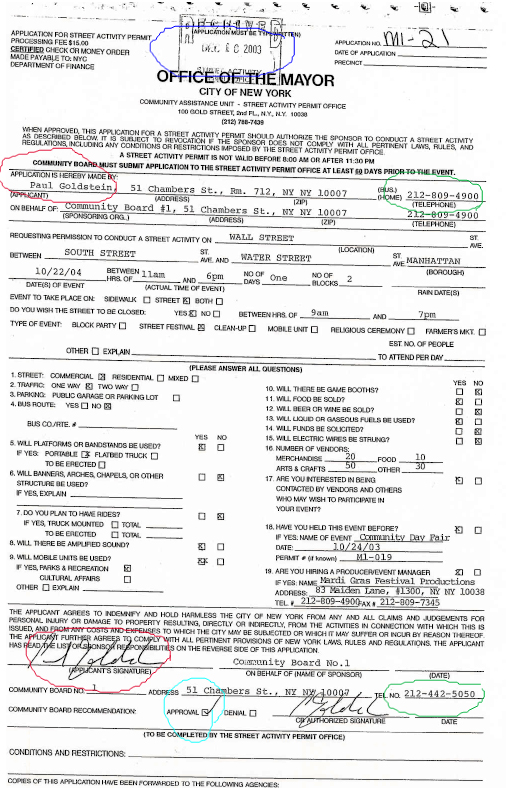
The following table shows the dates and location of the STREET FAIRS that are proposed on behalf of Community Board #1. As in the past, the “Name of Event” is not clearly defined. It is called “Community Day Fair”. But the money from the Street Fair Promoter goes directly into the budget of Community Board #1. None of this money (around $100,000 over the past ten years) goes to help Community projects (as Community Board #6 Brooklyn does when it gives fundraising money to its Youth programs). The money pays for the Board’s expenses (such as stamps, phones, copying, etc.) so that those funds can be used to increase the salaries of the City employees who support the Board.

The whole question of whether a City employee working for the Board should benefit from a profit making company does regularly does business with the Board is still under review by the Conflicts of Interest Board. But the policy question of whether the neighborhood should endure the problems and costs of seven Street Fairs just to increase the salaries of a few Board employees is something that deserves debate at the Board.

DATESLOCATION
May 6, 2005Murray Street , between Broadway and Church Streets
May 20, 2005 Maiden Lane, between South and Water Streets
June 17, 2005Wall Street, between South and Water Streets
July 8, 2005Maiden Lane, between South and Water Streets
August 12, 2005Maiden Lane, between South and Water Streets
September 16, 2005Wall Street, between South and Water Streets
October 21, 2005Maiden Lane, between South and Water Streets
All of the times are between 11 am and 6 pm. All of the events are being promoted by the same street fair promoter.

DIRECT QUOTE FROM THE MARCH 14, 2005 LETTER FROM THE CONFLICT OF INTEREST BOARD
"You are advised that, based on your representations, it would not violate Chapter 68 for CB1 to solicit funds from the Promoter, and to use them for CB1 salaries or non-personal expenses, provided that CB1 does not delegate to the CB1 District Manager, or other employees of CB1, the authority to both negotiate with the promoter concerning the price and other terms and conditions pertaining to the street fairs that raise funds for CB1 and also to pass on street fair permits sought by that promoter."


When are people speaking for "Friends" or Community Board #1?

Twice last year people first said that something was being done by either the Community Board or Friends of CB#1 and then changed their minds. At first Paul mentioned at a Seaport Committee Meeting that the Street Fairs in question were sponsored by "Friends of CB#1". He later told me that he was mistaken and that they were sponsored by "CB#1".

The private strategy sessions were originally called a Tribeca Sub-committee of CB#1 and then I was told that maybe it was the "Friends" that were conducting the private meetings. The consultant to propose a Zoning Change for North Tribeca was hired by "Friends" and then the preliminary concept was presented to the Tribeca Committee without the Subcommittee ever even meeting. We need to clarify who is what considering that the budget of "Friends" is larger than the budget of CB#1. Some people are wearing so many hats, that it is hard to know when they represent which agency.